Start with the communication job
Each module leads towards a workplace performance task. Outcomes, useful language, inputs and assessment are selected for what learners need to accomplish together.
Built for You
A corporate-English learning system built around the moments when teams need to clarify, coordinate and act together.
A complete year-programme architecture, with one representative module developed in full.
Delivery: Flexible online programme delivery
B1+–B2 · 30 weeks · 10 modules
Built from a sample brief written to demonstrate how Content Studio approaches a real corporate-English commission.
Programme architecture
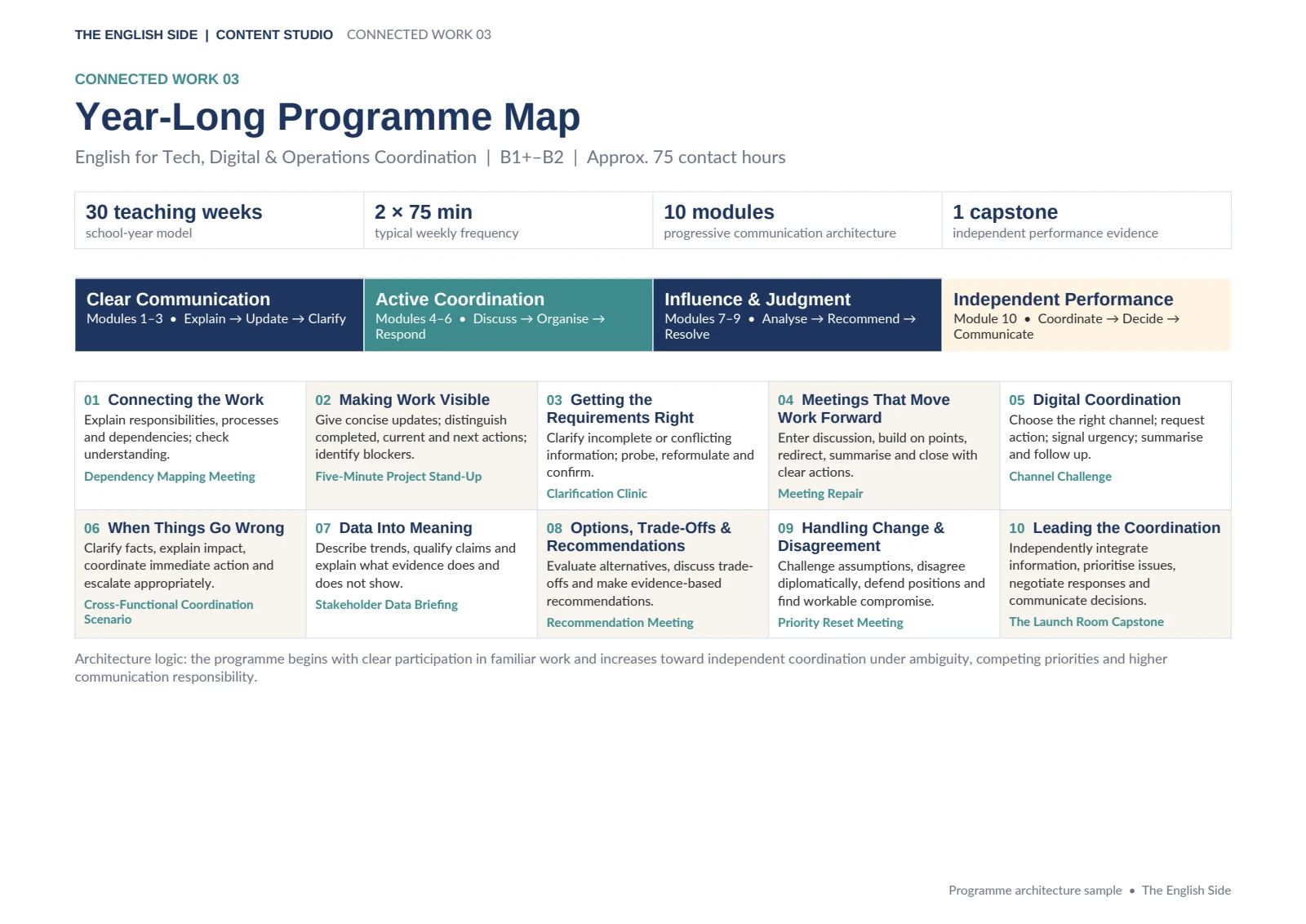
30 teaching weeks · approximately 75 contact hours · 10 progressive modules
The year architecture connects the programme brief, progression and module-level design.
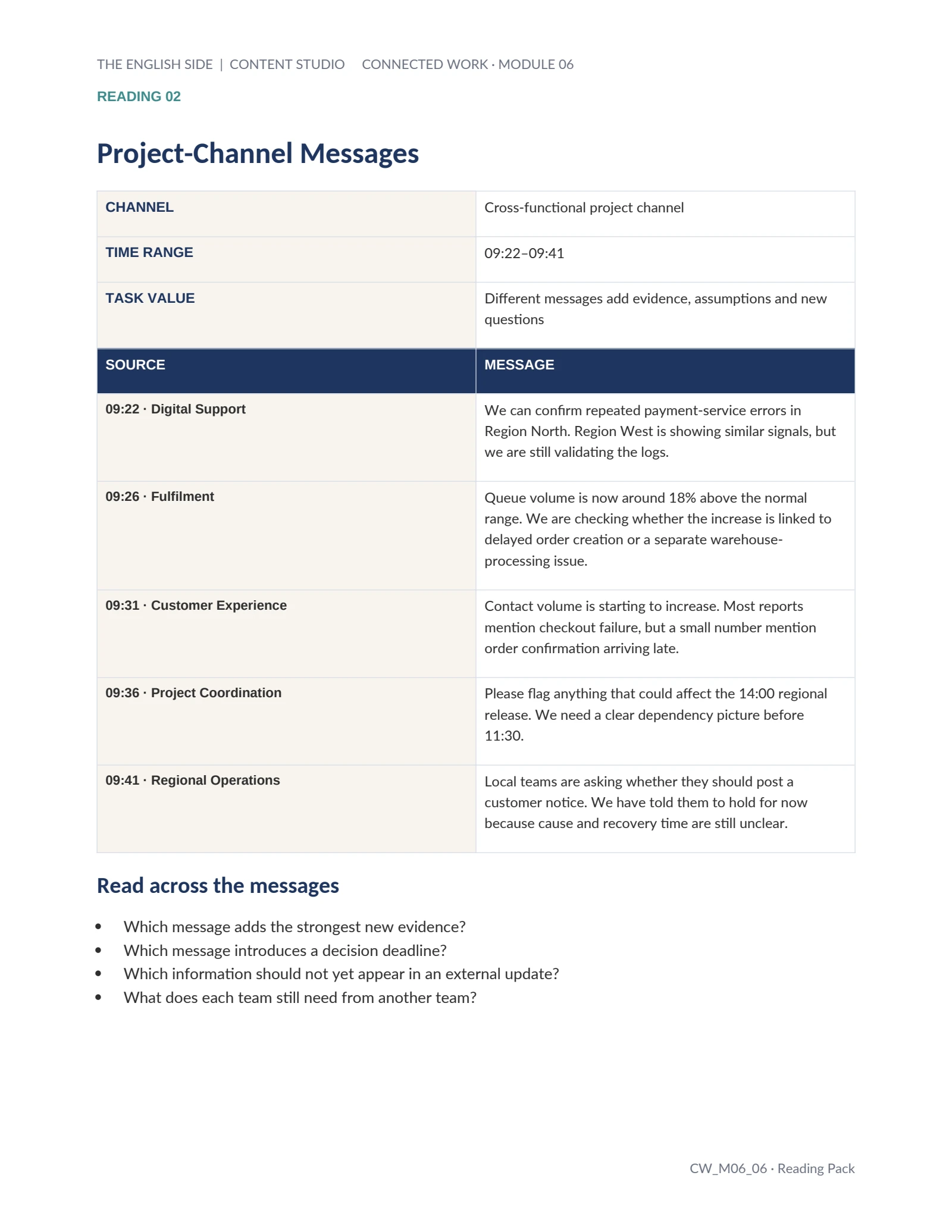
Original English excerpts. Open each image to read it at full size.
Year-long programme map
 View full-size image (opens in a new tab)
Learners already use English at work. The challenge is making useful decisions and updates when facts are still emerging, responsibilities overlap and other teams depend on the answer. The brief calls for cross-functional B1+–B2 learning, with support and stretch within the same task and practical guidance for coherent trainer delivery. The focus is communication performance: separating evidence from assumptions, asking better questions and agreeing a clear next step.
The programme map and master syllabus cover all ten modules. The sequence moves from clear individual contributions to independent coordination, with diagnostic and review work around the core modules. Module 6 provides the fully developed delivery example.
Explain responsibilities, give useful updates and clarify requirements.
Move discussions into action, choose channels and respond to operational problems.
Interpret evidence, recommend options and handle changing priorities diplomatically.
Integrate decisions, negotiation and stakeholder communication in a final coordination task.
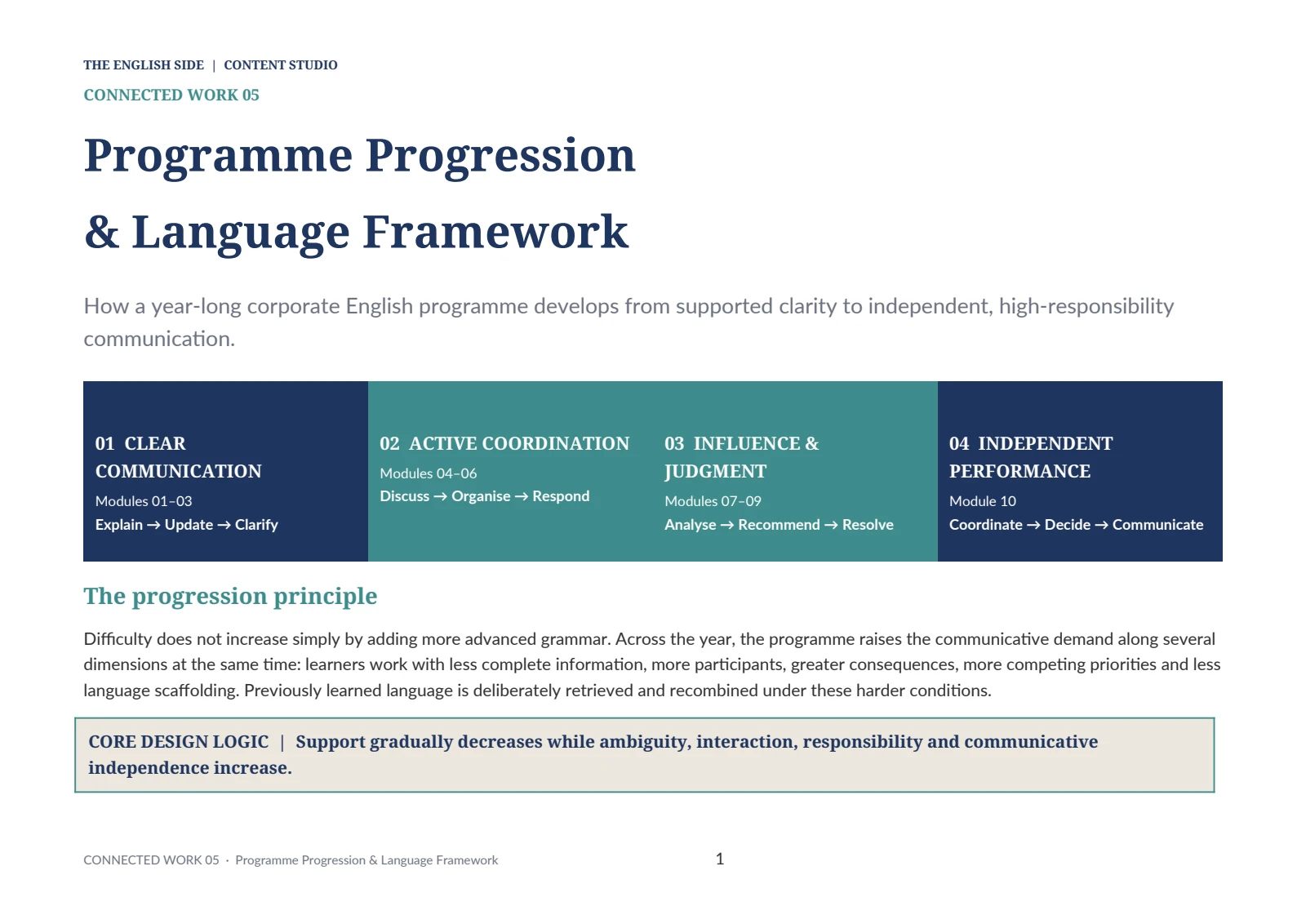
Learning progression
Support reduces as ambiguity, interaction and responsibility increase.
Communication demand grows through ambiguity, interaction and responsibility across the ten modules.
Original English excerpts. Open each image to read it at full size.
Programme progression framework
 View full-size image (opens in a new tab)
Module 6 · When Things Go Wrong brings earlier work on updates, clarification, meetings and digital messages together under uncertainty. Its five 75-minute sessions make the relationship between input, language, practice and performance visible in one complete module.
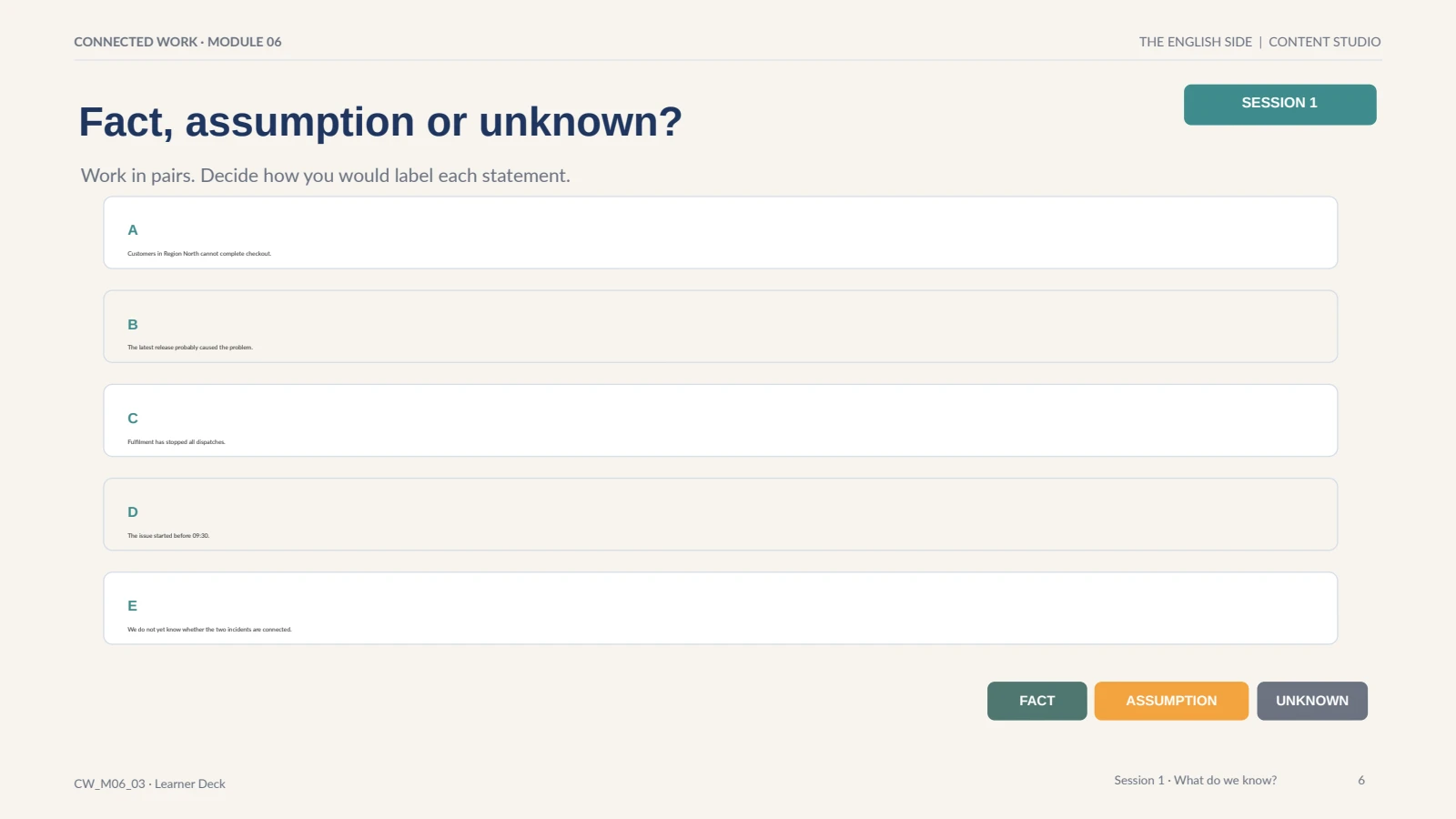
Separate facts, assumptions and unknowns; ask targeted questions and build a shared situation board.
Trace dependencies and risks, then explain possible consequences and contingencies.
Compare priorities, agree ownership and decide what needs escalation in a shared action list.
Turn the same evidence into a concise written update and a spoken briefing for a specific audience.
Respond to changing information in the final scenario, agree an action plan and final update, then reflect on observable performance.
Learner experience
Context → noticing → language → coordination → final performance
The 59-slide learner deck gives the module a shared classroom sequence, from initial evidence to final performance.
Original English excerpts. Open each image to read it at full size.
Session 1 · Facts, assumptions and unknowns
 View full-size image (opens in a new tab)
Session 2 · Likely consequences
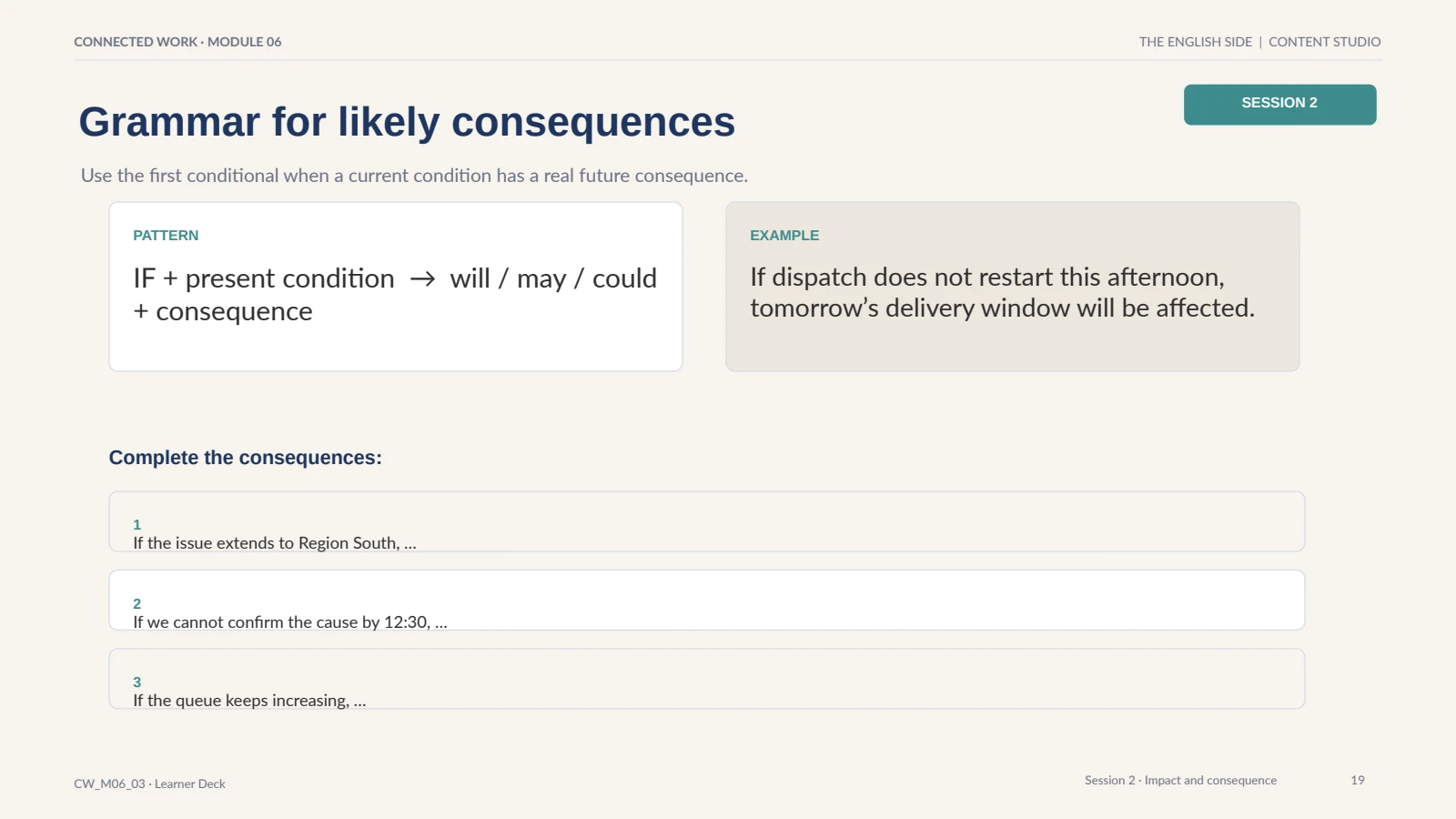 View full-size image (opens in a new tab)
Session 3 · Coordinating action
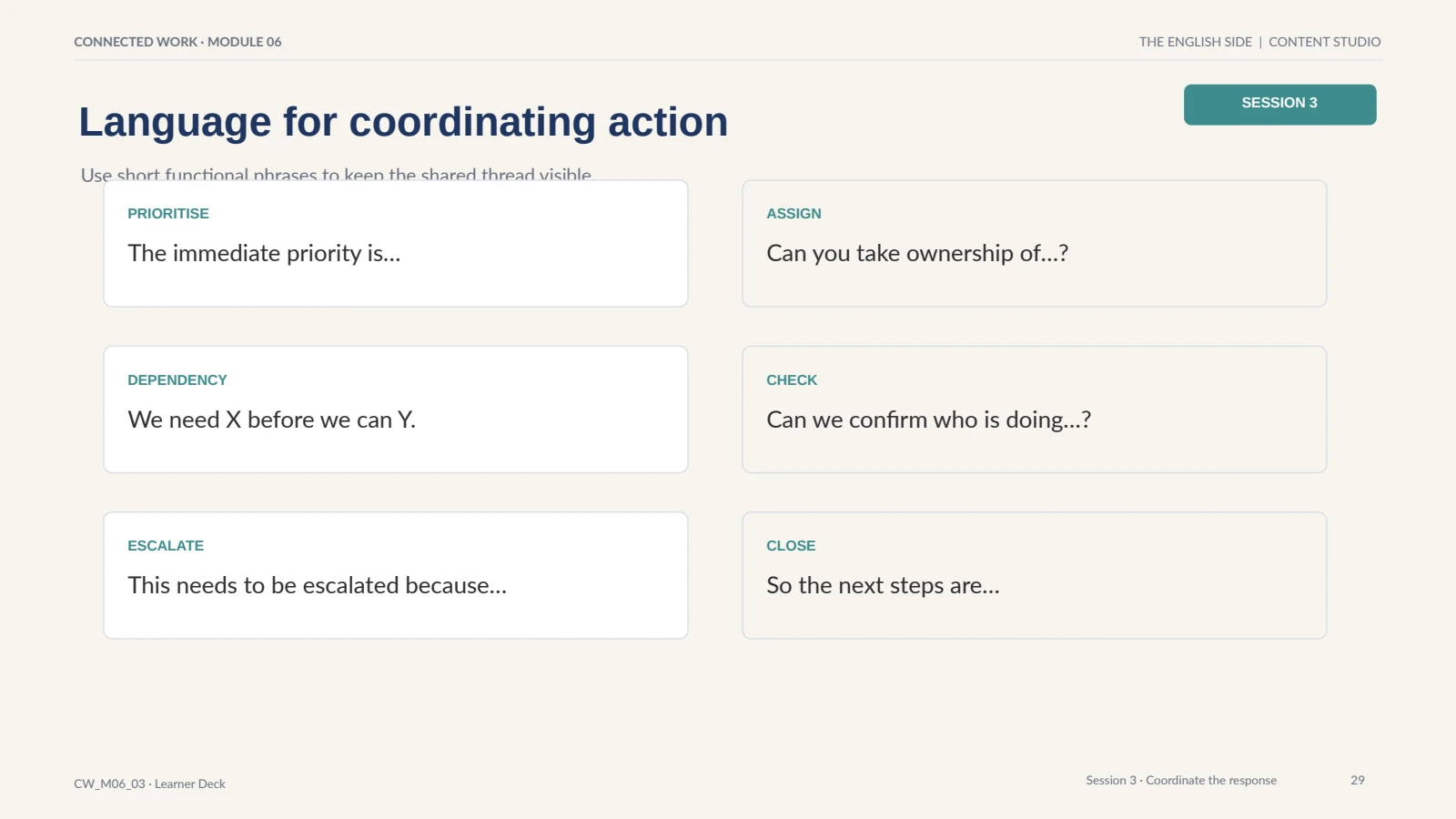 View full-size image (opens in a new tab)
Session 4 · Stakeholder update
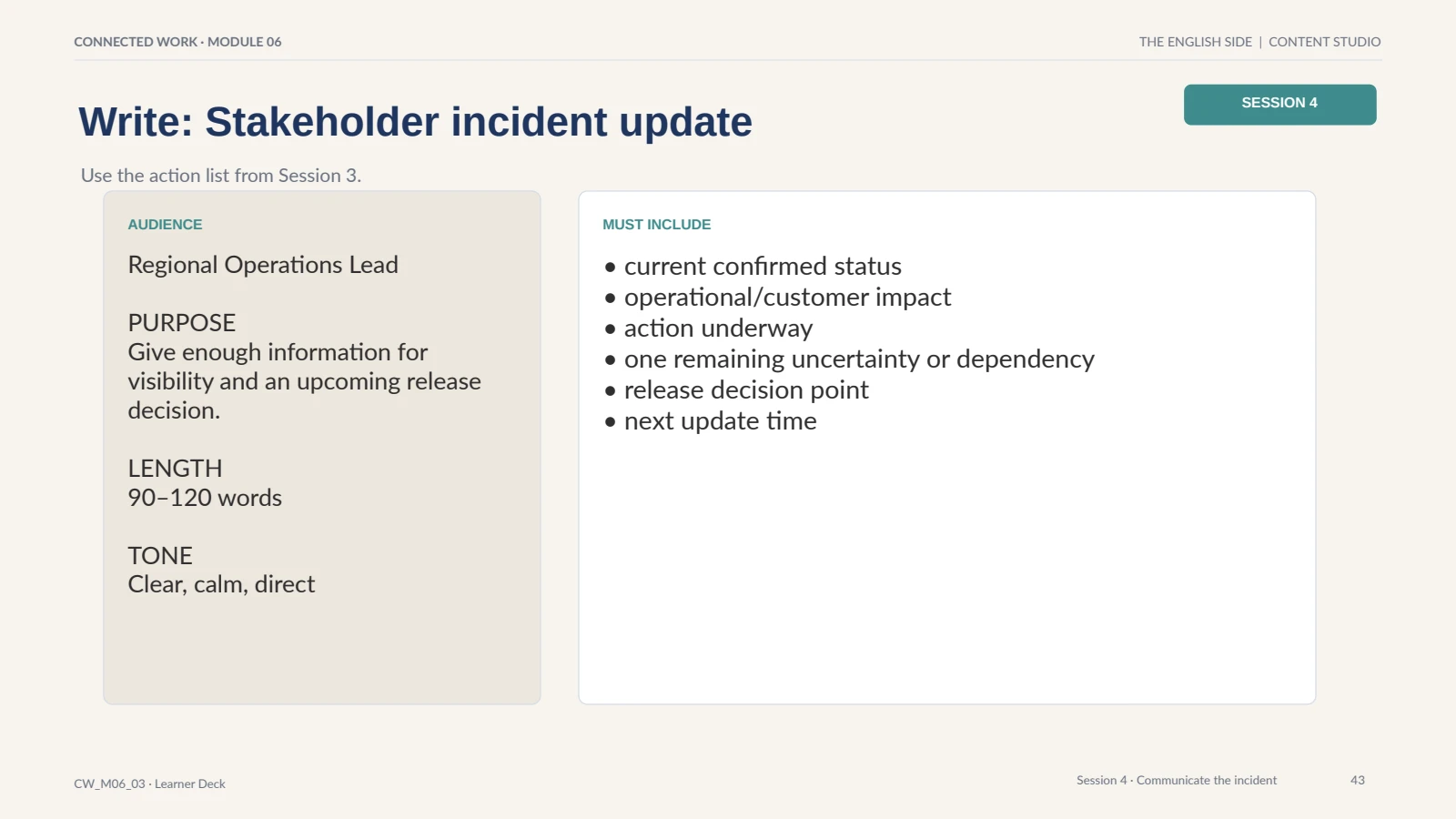 View full-size image (opens in a new tab)
Session 5 · Final performance task
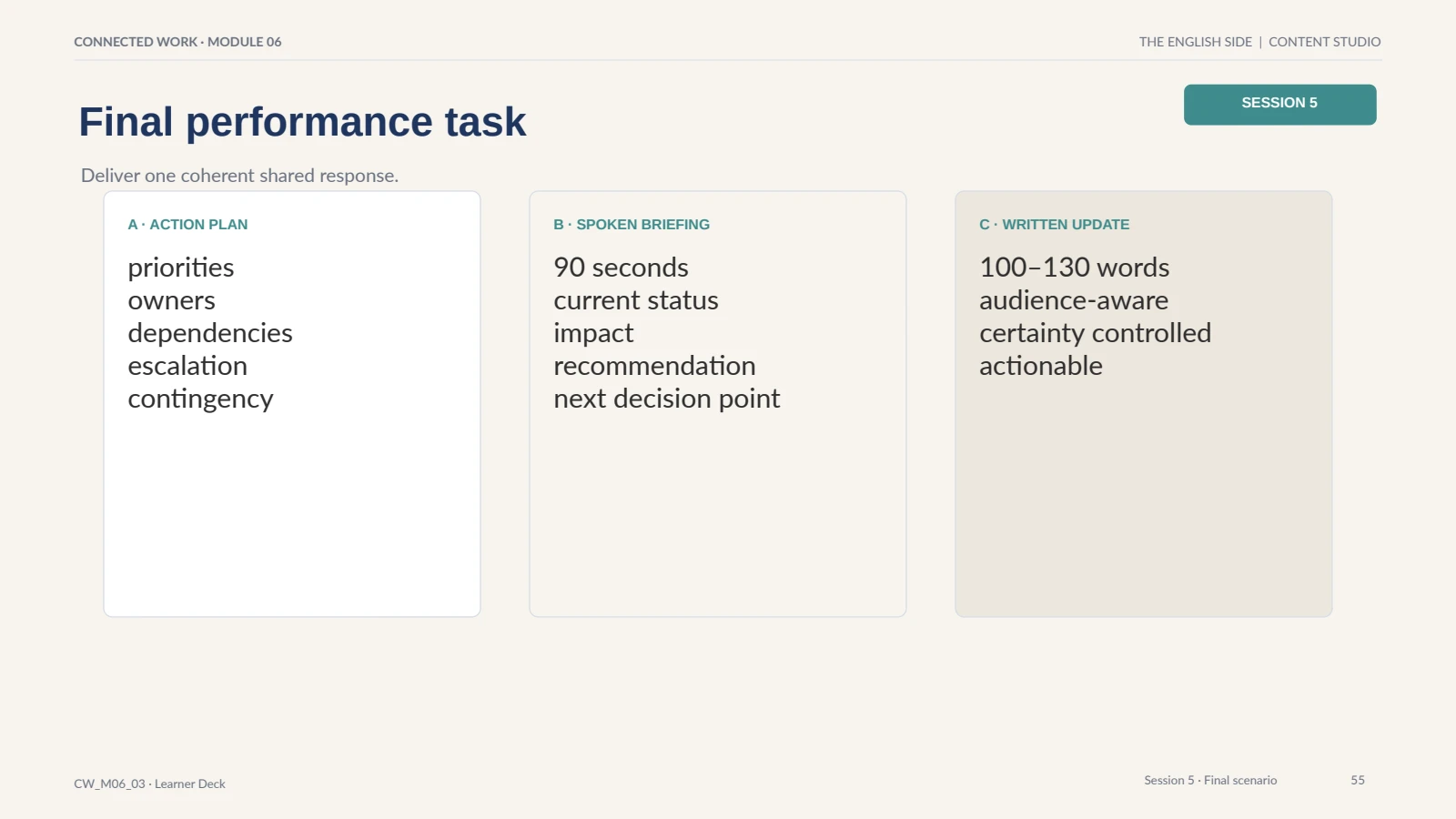 View full-size image (opens in a new tab)
Multi-format learning materials
Original workplace texts · participant planning · language scaffolding
Original workplace inputs, participant planning and targeted language support serve the same communication task.
Original English excerpts. Open each image to read it at full size.
Participant planning
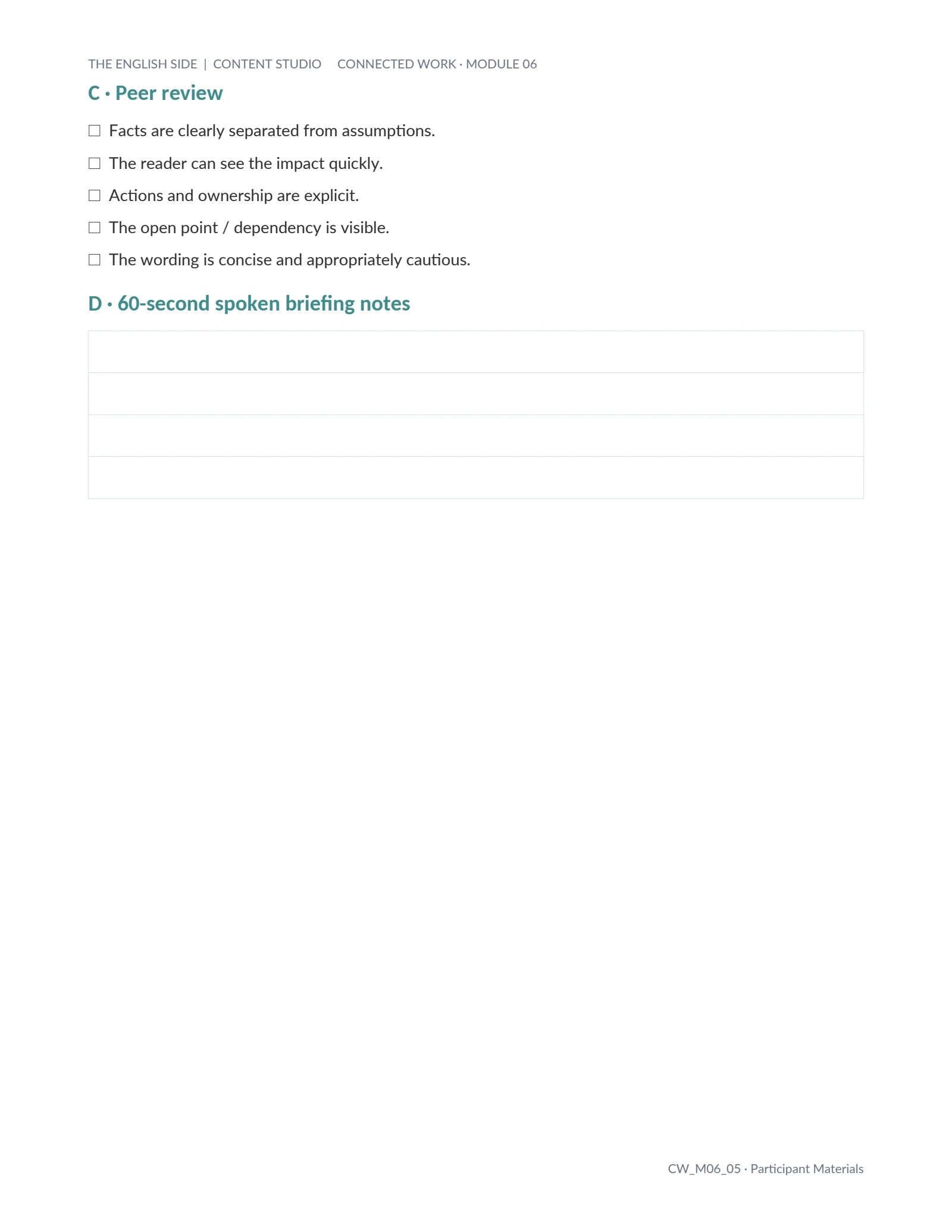 View full-size image (opens in a new tab)
Language support
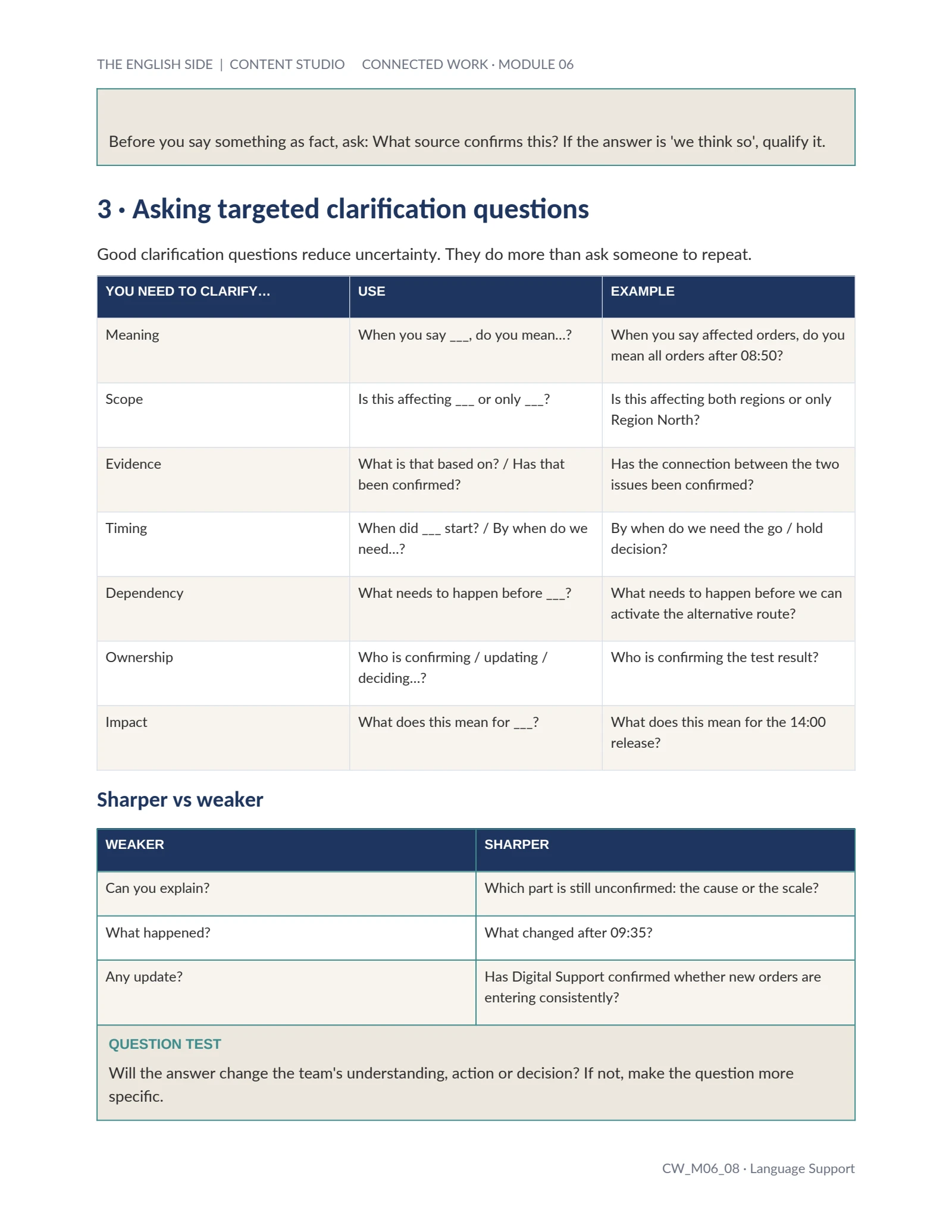 View full-size image (opens in a new tab)
Distributed-information scenario
Incomplete information · changing evidence · a shared response
The performance task asks learners to combine partial information and coordinate a response across roles.
Original English excerpts. Open each image to read it at full size.
Digital support
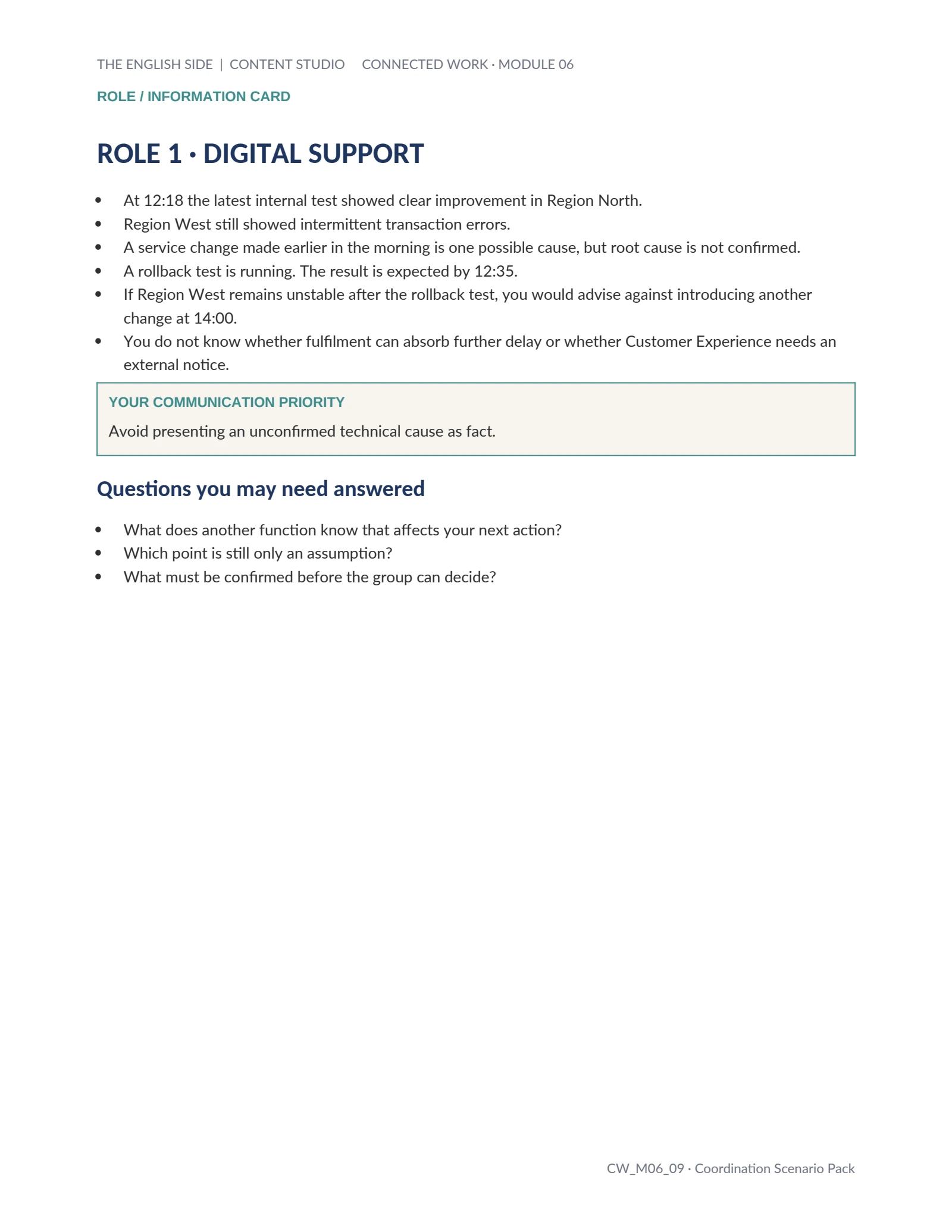 View full-size image (opens in a new tab)
Fulfilment operations
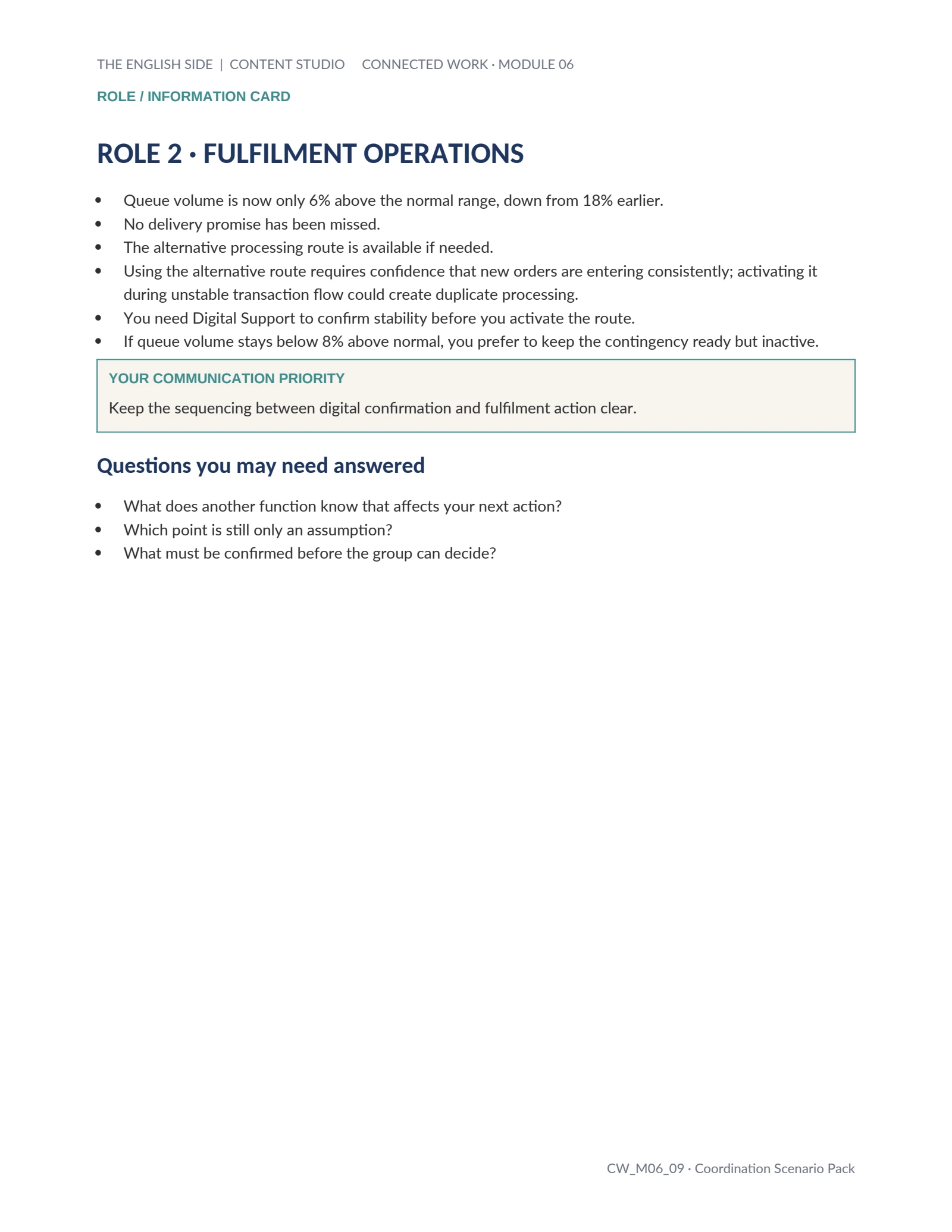 View full-size image (opens in a new tab)
Customer experience
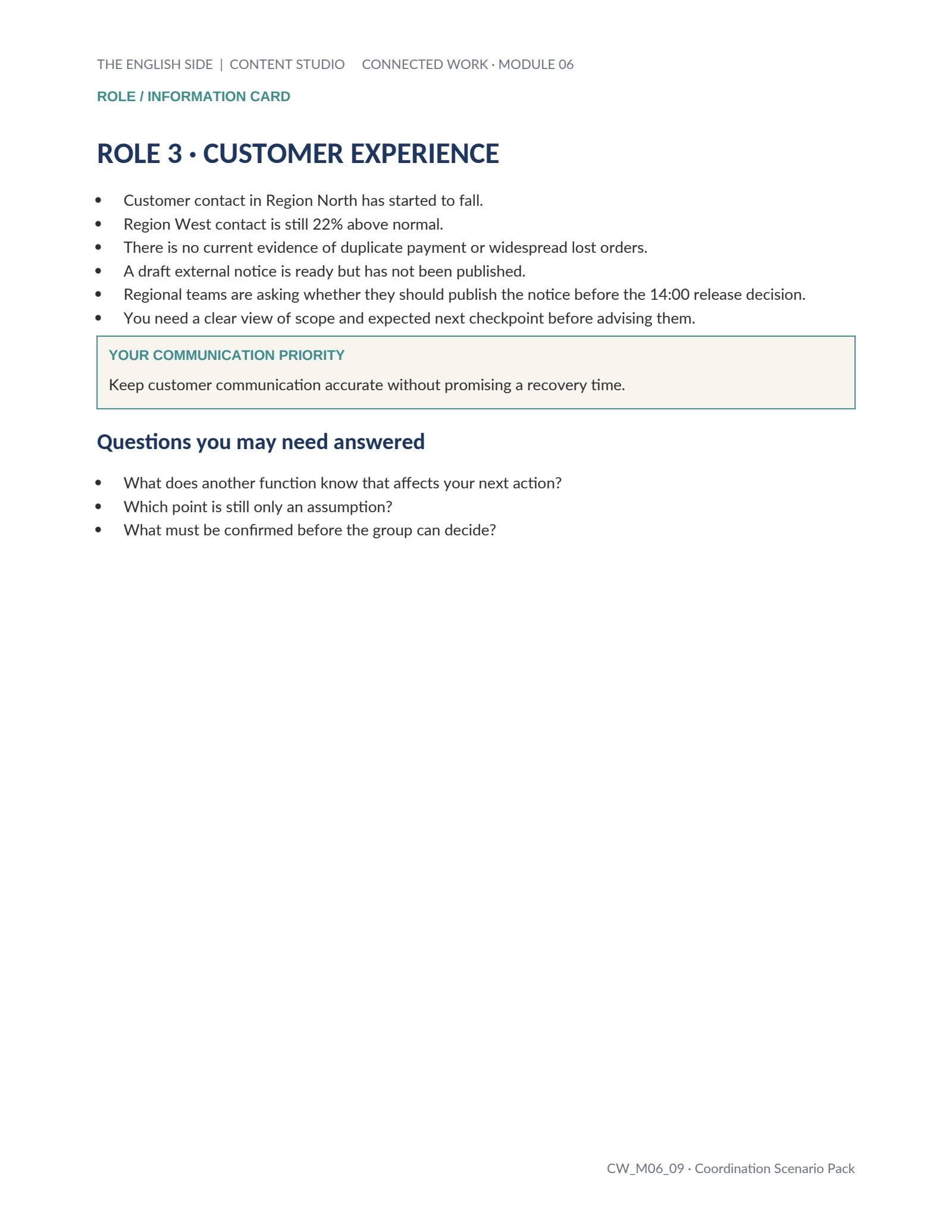 View full-size image (opens in a new tab)
Project coordination
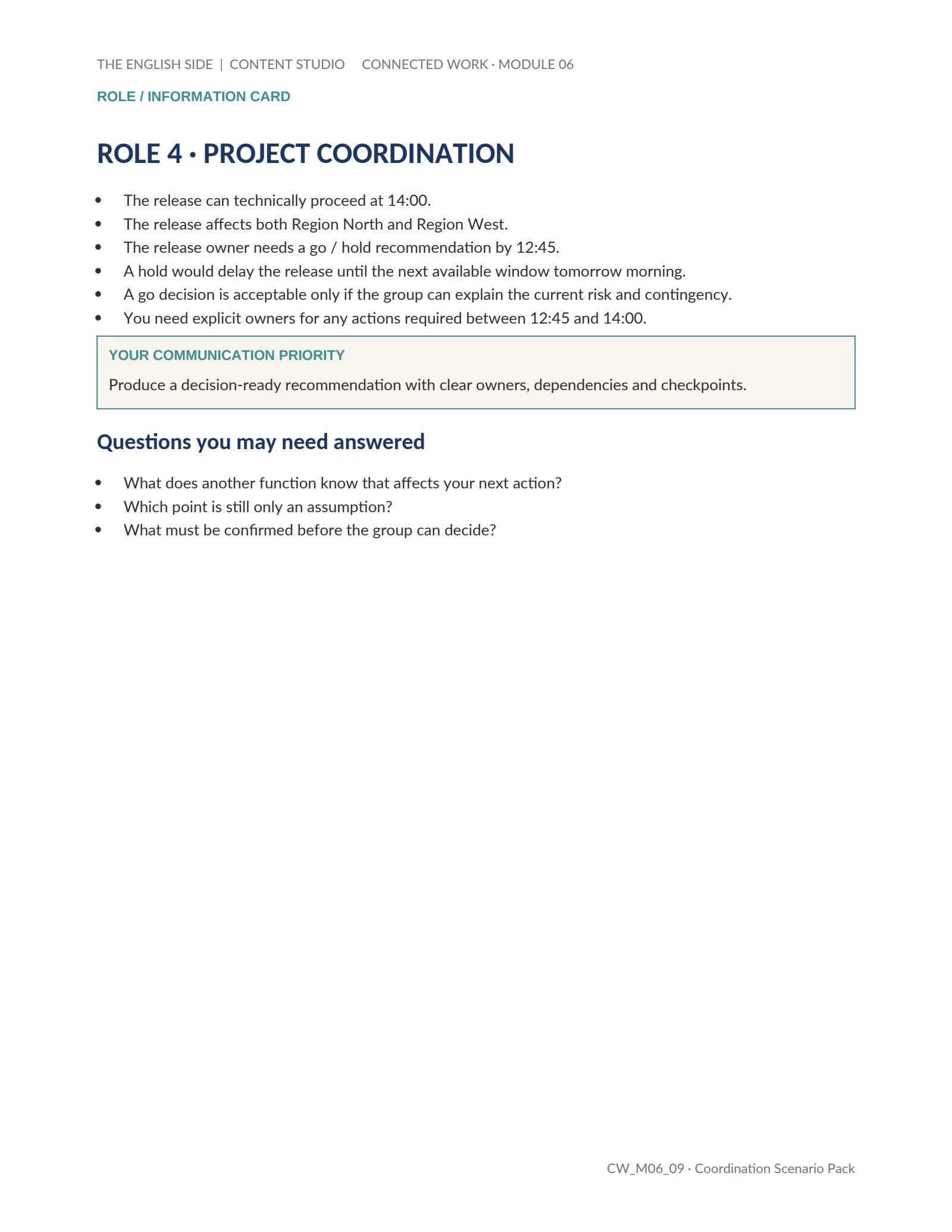 View full-size image (opens in a new tab)
One module, developed as a complete delivery system.
The value is not any single file. It is the coherence between them.
Each asset is built from the same brief, outcomes, language progression and performance task.
Trainer-ready delivery
Timing, purpose, instructions, answers, differentiation and observation
The trainer guide connects the sequence to practical delivery decisions, anticipated difficulties and support options.
Original English excerpts. Open each image to read it at full size.
Session 1 · Trainer guidance
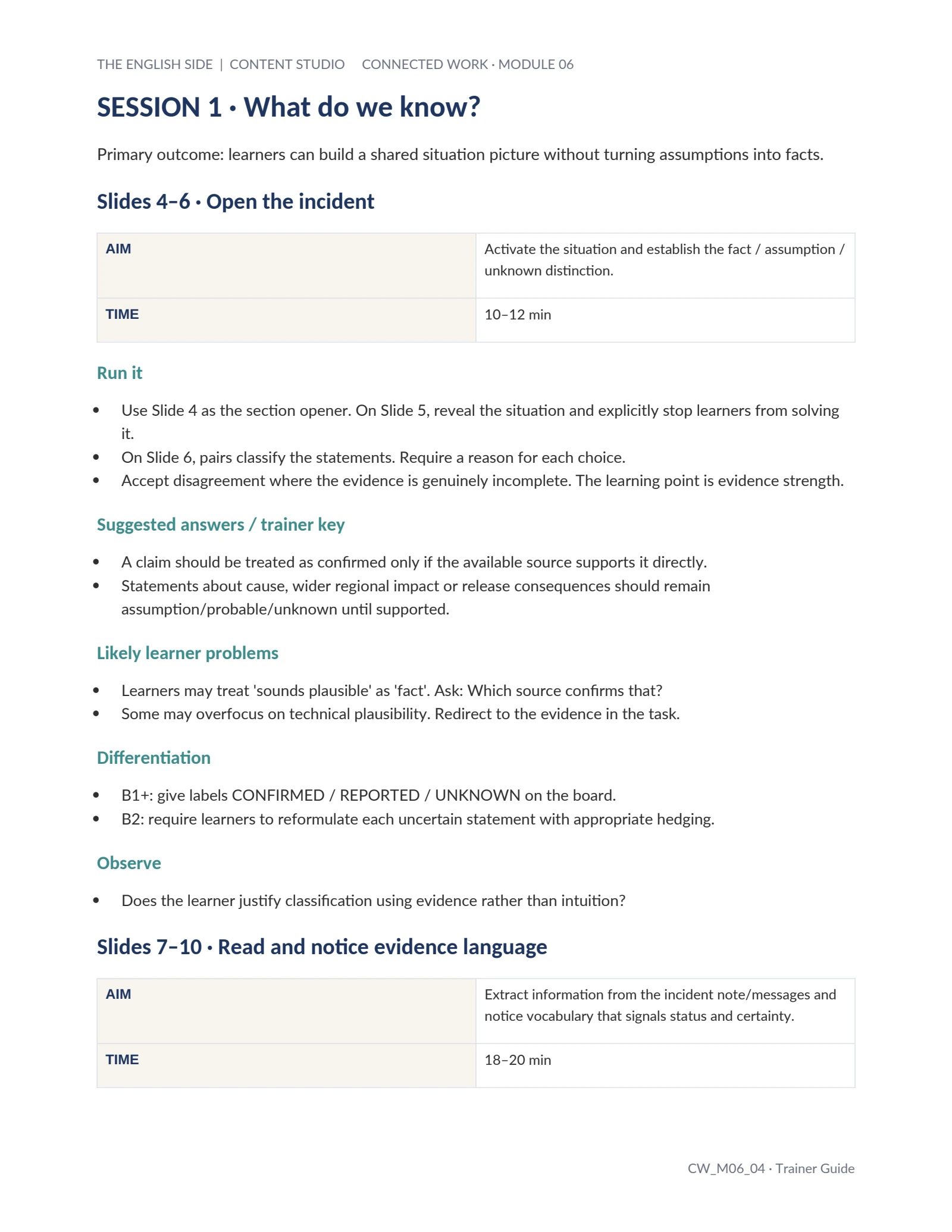 View full-size image (opens in a new tab)
Session 4 · Trainer guidance
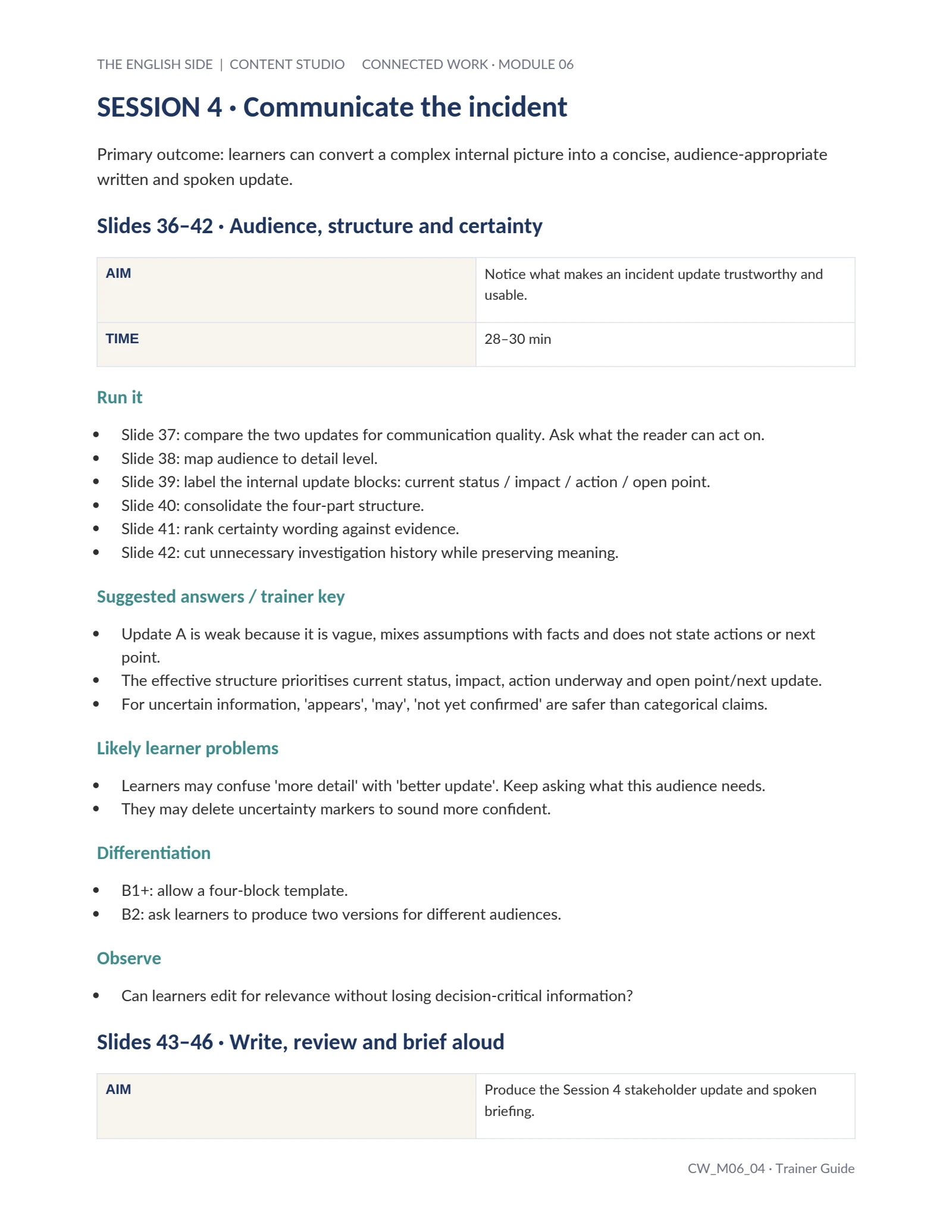 View full-size image (opens in a new tab)
Performance assessment
Six dimensions of final performance
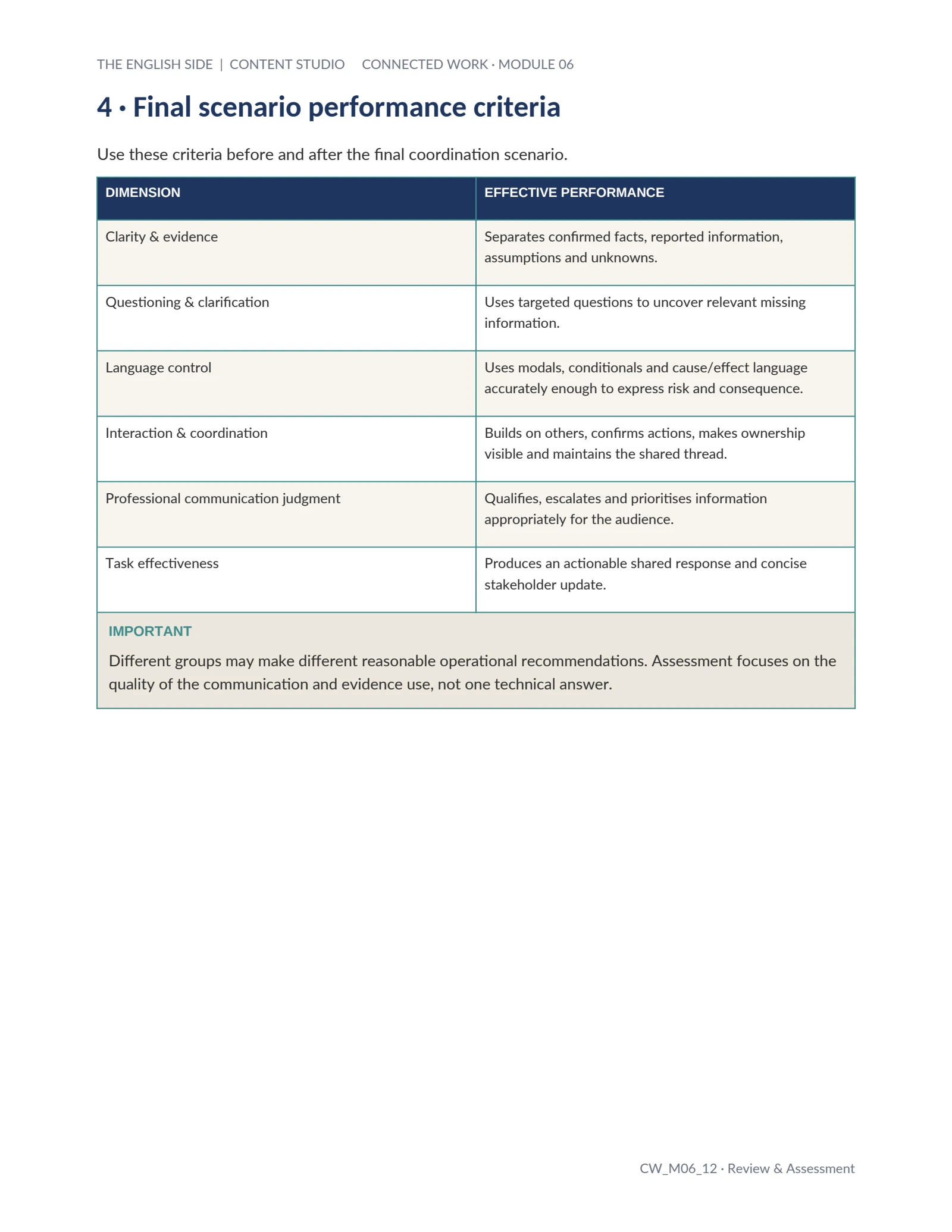
Assessment looks for clarity, questioning, language control, interaction, professional judgment and task effectiveness.
Original English excerpts. Open each image to read it at full size.
Final scenario performance criteria
 View full-size image (opens in a new tab)
For a commission of this kind, the agreed scope could bring together the following. Final deliverables and editable formats would be defined around the client’s brief and delivery context.
A three-page overview of the module’s purpose, five-session structure and delivery logic. This is the original English PDF; it gives a useful view of the design without releasing the full delivery pack.
A new programme, one carefully developed module, stronger existing materials or extra content-development capacity: tell Content Studio about your audience and delivery context.
Discuss a Studio project